How to travel India by regions? A myriad of cultures, landscapes, food, and languages, the country has a lot to offer. It can be a beautiful experience, albeit chaotic, to travel the length and breadth of India. The best way to explore the country is by breaking it down by regions. Read on to find out more!
North India
One of the most popular regions in India among domestic as well as foreign travelers, North India covers Delhi, Rajasthan, Jammu and Kashmir, Leh and Ladakh, Himachal Pradesh, Uttarakhand, and Uttar Pradesh.
What to see
North India offers history, culture, tradition, and some of the most stunning landscapes in the world. The Taj Mahal in Agra, Red Fort in Delhi, Hawa Mahal in Jaipur, and many other heritage monuments are located here. North India also has beautiful and diverse landscapes – the snowy white regions of the Himalayas, the rugged mountains of Leh, the pristine beauty of Kashmir, and the golden deserts of Rajasthan.
Best time to visit
If you are visiting the mountain regions in the far north, April to June and September to October is the best time to visit. If you want to experience snow, December to February is the time to go, although many roads are blocked due to heavy snow.
If you are visiting the plains in the north, October to March is the perfect time to explore the regions. The climate is cool and pleasant. Budget travelers can also visit during the monsoon season from June to September, since it does not rain very intensely in many northern regions.
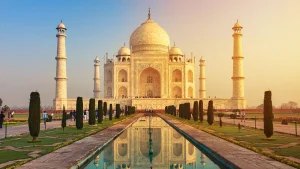 Taj Mahal in Agra is in North India (Photo Credit Julian-yu)
South India
Covering the states of Karnataka, Kerala, Tamil Nadu, Andhra Pradesh, and Telangana, plus the union territories of Pondicherry and Andaman and Nicobar Islands, South India offers a laid-back vibe with its beautiful spice plantations, backwaters, and ancient temples. A serene escape from the chaos of the north, the southern part of India is perfect for travelers looking to relax.
What to see
Enjoy the backwaters of Kerala and cruise in a houseboat, visit the coffee estates in Coorg and Munnar, and explore the stunning temples of Hampi, Madurai, Thanjavur, and Mahabalipuram.
Best time to visit
The best time to visit South India is from November to March, when the climate is cool and ideal for sightseeing and exploring the region.

Central India
The states of Madhya Pradesh and Chhattisgarh in Central India are less frequented, but this region is perfect for history lovers and wildlife enthusiasts, with dense jungles, abundant tigers, beautiful temples, and unique cultures.
What to see
Go on a wildlife safari in one of the many tiger reserves such as Kanha, Pench, and Bandhavgarh. Visit the Khajuraho Temples, a UNESCO World Heritage Site.
Best time to visit
The best time to visit Central India is from October to March. The weather is quite pleasant for exploring the outdoors and going on wildlife safaris. However, for the best chances of spotting tigers and other wildlife, the summer season from March to May is ideal, although the extreme heat can make it an unpleasant experience.

West India
The states of Gujarat, Maharashtra, Goa, parts of Rajasthan, and the union territories of Daman and Diu and Dadra and Nagar Haveli form West India. This part of the country has a bit of everything – mighty mountains, beautiful beaches, abundant wildlife, historic monuments, glittering cities, and sleepy towns.
What to see
Visit Mumbai, the Bollywood headquarters, the picturesque beaches of the party capital Goa, wine country in Nashik, the wildlife in Maharashtra and Gujarat, and the ancient temples and mighty forts in the region. The white salt desert of Kutch is perfect to visit during the Rann Utsav in the winter season.
Best time to visit
The best time to visit Western India is from October to March. The cool climate is ideal for relaxing on the beaches, water sports and activities, and for exploring the heritage monuments in the region. Summers from April to June can be extremely harsh, so try to avoid this time, although Goa is busy even during this time of the year. The monsoon season from June to September is good for monsoon treks and beautiful landscapes, although heavy rains can be an issue.

East India
Comprising the states of West Bengal, Odisha, Jharkhand, and Bihar, East India is not a tourist hub. However, it offers some of the most unique cultures with vibrant festivals, stunning landscapes, beautiful architecture, and cities that take you back in time.
What to see
Explore the bygone area in Kolkata with its trams, art, food, and culture, drive along the lush tea estates of Darjeeling, and experience unique tribes in Odisha. Spiritual and religious travelers can visit the ancient temples at Puri and Konark, or learn the Buddhist history at Bodh Gaya, the place where Gautama Buddha attained enlightenment.
Best time to visit
The best time to visit East India is from October to February. The clear skies and pleasant weather are good for exploring the cities, wildlife sightings, and visiting ancient temples. The festivals of Durga Puja and Rath Yatra also take place during this season. Summers from April to June are a good time to visit hill stations like Darjeeling and Mirik.

Northeast India
The seven sisters Assam, Meghalaya, Arunachal Pradesh, Mizoram, Manipur, Nagaland, and Tripura, and its brother state Sikkim together make up Northeast India. Visiting this region is like being transported into a different world, with enchanting rainforests, misty weather, and tribal cultures.
What to see
See the living root bridges in Meghalaya, and visit the beautiful Buddhist monasteries in Sikkim. For wildlife lovers, Kaziranga National Park is a must-visit. Explore the culture of the region through its local cuisine, festivals like Ziro Festival and Hornbill Festival, and unique villages like Mawlynnong, the cleanest village in Asia.
Best time to visit
The best time to visit Northeast India is from October to April. October and November is the perfect time to visit any of the eight states, with post-monsoon greenery and clear skies.

How to plan your trip to India across all regions
Decide the duration of your trip
Exploring the entire country of India is a mammoth task, definitely something that cannot be done in a week or two. If you are planning to explore all the regions of India, you will need anywhere between three months to one year, and even then you may not have experienced everything the country has to offer in its entirety. It is a good idea to spend at least 3 to 4 weeks in each region.
Map out your route
Choose the regions you wish to visit and chalk out a map that will help you understand the flow of your route. Do you want to start in the south and end in the north or vice versa? It is a good idea to clarify this first. Then you can decide the places you want to visit within the regions.
Decide when to go
India has different seasons in different regions at different times of the year. You need to plan your trip and route according to the seasons as well. Most of India is best visited from October to March. April to June is the hot summer season in many parts of India, but it is ideal for the Himalayan regions. June to September is the monsoon season, avoided by most people for tourism, but it is great for Ladakh, Tamil Nadu, and parts of Rajasthan which do not receive very heavy rainfall.
Budgeting
Decide whether you want to travel in luxury, comfort, or on a stringent budget. This is very important since you will be booking everything accordingly. India is not a very expensive country, but if you are planning on exploring the entire country, you will need to budget properly.
Preparations
Pack for India according to the regions you are visiting and the seasons when you are going. Pack a first aid kid, mosquito repellent, and hand sanitizer. Consult your doctor and take the necessary vaccines, carry all your documents and copies, and book everything beforehand.
Permits and documents
You will need the essential documents like a valid passport and visa, return or onward ticket, proof of accommodation, and travel insurance, which are all needed at the airport. You may also need a few passport-size photos for a SIM card, as well as driving permits to rent a car or scooter.
Some border regions of India like Ladakh, Arunachal Pradesh, and Sikkim require Protected Area Permits (PAP). You will also need safari permits for national parks like Jim Corbett, Ranthambore, Kaziranga, Kanha, Pench, and Periyar.
See also: Essential travel documents to carry to India

Did you find this guide useful? Let us know! At India Someday, we curate personalized trips to India based on your likes and preferences. Contact us and together we can plan the perfect trip to India for you!
Frequently Asked Questions
North, South, East, West, Central, and Northeast are the main regions of India.
The seven sisters of India refer to the seven states Arunachal Pradesh, Assam, Meghalaya, Manipur, Mizoram, Nagaland, and Tripura located in the northeast. Sikkim is known as the “brother” state of these seven sisters. They are called this because of the similarities in the region.
There are 28 states and 8 union territories in India.
Domestic flights and trains are the best way to travel across India.
To get between cities with shorter distances, you can hire a cab or go by bus. For slightly longer distances, trains are the best choice.
Land transport is usually inexpensive in India. Trains and buses are the cheapest modes of transport, while car rates can be higher over longer distances.
India Someday is one of the best travel tour companies in India. We help you curate personalized itineraries across India with complete transparency and 24/7 assistance.
Khajjiar in Himachal Pradesh is often called the “Mini Switzerland of India” due to its picturesque landscapes, pine forests, and verdant meadows.
Madhya Pradesh is known as the heart of India, since it is located in the central part of the country. The name Madhya Pradesh literally translates to “Central Province”.
Safety in a place depends on a lot of factors, but some of the states ranking high for overall safety include Maharashtra, Gujarat, Nagaland, Meghalaya, and Kerala.

About Aishwarya Shete
Aishwarya Shete is a content writer at India Someday. Her passions are writing, photography, and more importantly, food. She hopes to travel the world someday and document it through her pictures and words.
helping you travel your way
Everything you need to know about India is here We have tried writing about everything you may need help with for your trip to India, If you need help in planning a trip to India Get in touch with us to to plan your trip of a life time.